Three Card Poker Malaysia – Ante-Play & Pair Plus Strategy Guide
Three Card Poker remains one of the quickest-decision live poker variants on offer at Maxim88 Malaysia. Working with only three cards each, you go head-to-head against the dealer on the Ante-Play wager while a separate Pair Plus side bet rewards a strong hand no matter what the dealer is holding. Because a full round takes mere seconds and only one strategic decision is required per hand, it delivers a high volume of action and genuinely good entertainment value per hour at the live tables.
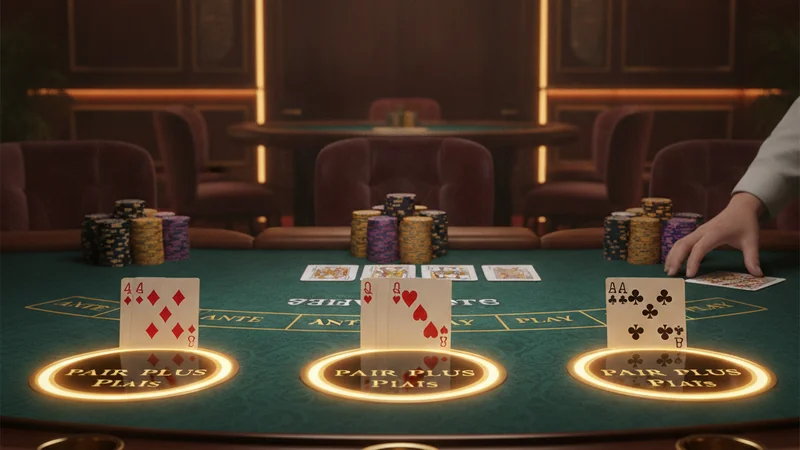
What is Three Card Poker?
Three Card Poker is a casino poker game where both player and dealer receive exactly three cards. Players first decide whether to play against the dealer (Ante-Play) or forfeit, and can optionally place a Pair Plus side bet that pays based purely on hand quality regardless of what the dealer holds.
How to Play Three Card Poker
- Place Ante bet. Required bet to compete against the dealer.
- Pair Plus (optional). Side bet that pays if you hold a pair or better, regardless of dealer result.
- Three cards dealt. Player and dealer each receive three cards. Dealer cards are face-down.
- Play or Fold. After viewing your cards, either match the Ante with a Play bet or fold.
- Dealer qualifies. Dealer must have Queen-high or better to qualify. If not, Ante wins at 1:1 and Play pushes.
Hand Rankings (Highest to Lowest)
Straight Flush, Three of a Kind, Straight, Flush, Pair, High Card, using only three cards, so rankings differ slightly from standard five-card poker.
Optimal Strategy
Tip 1: The Queen-Six-Four Rule
The optimal Three Card Poker strategy is simple: Play if your hand is Q-6-4 or better, Fold if worse. This single rule covers the vast majority of decisions and keeps the house edge under 3.4% on the Ante-Play combined.
Tip 2: Pair Plus Has Positive Expected Value Opportunity
The Pair Plus bet carries a house edge of approximately 2.3-7% depending on the pay table. Always check the Pair Plus pay table at your specific table before committing to this side bet regularly.
Tip 3: Never Fold a Made Hand
One mistake that quietly costs Malaysian players money is folding a pair or any straight. Even a low pair sits well above the Q-6-4 threshold, so always match the Ante with a Play bet whenever you hold a pair or better, surrendering such a hand throws away a clear mathematical advantage.
Providers at Maxim88
- Evolution Gaming, Premium Three Card Poker tables with professional live dealer environments.
- Playtech, Offers Three Card Poker in their established live poker game lineup.
Q-6-4, the Three Characters Worth Memorising
The entire playing strategy of Three Card Poker compresses into a single threshold hand, Queen-Six-Four. Hold anything that beats it and the Play bet goes in, hold anything weaker and the hand folds, with nothing else to remember and no exceptions worth the ink. The threshold exists because the dealer qualifies with Queen-high or better, and the mathematics of that boundary settle exactly at Q-6-4, below which even a qualifying dealer beats you too often to justify the Play wager. One memorised hand and the game plays itself, which is precisely the appeal. Among live poker variants only this one lets a player reach near-optimal play inside their first shoe, and the published cost of the Ante-Play game at correct strategy is respectable company for a table this fast.
Two Games Sharing One Table
Pair Plus is not a side bet in the usual sense so much as a second, independent game dealt from the same cards. It pays purely on your hand's quality, a pair upward through the ladder to the straight flush, indifferent to the dealer entirely, and its price is set by its own paytable rather than the main game's. Plenty of players run the two wagers in deliberate proportion, the Ante-Play as the strategic spine and Pair Plus as the per-hand story, and the proportion is worth deciding in advance because the Pair Plus ladder pays rarely enough that its stake is best treated as spent on arrival. Paytables for both games vary between tables in the small print, and the panel check remains the one piece of homework the format asks.
Speed Is the Format's Gift and Its Bill
Rounds resolve in seconds, three cards against three cards with one decision between them, and the pace delivers the entertainment density the game is loved for. It also delivers volume, and the arithmetic that governs every fast format applies without mercy, hands per hour times cost per hand. The stake that suits Three Card Poker is therefore a notch below what the same bankroll would play at a slower poker table, sized so that the quick succession of small results stays fun rather than consequential. The game's inventor built it in the 1990s explicitly to be poker at casino tempo, and half a century of table-game design wisdom is visible in how well the trade-offs balance, provided the player prices the tempo honestly.
The Game's Design, Appreciated Properly
Three Card Poker is a masterclass in table game engineering, and knowing its construction adds something to playing it. Derek Webb designed it in the 1990s with explicit targets, a game dealers could run fast, players could learn in one hand, and casinos could host profitably at a fair-feeling price, and he toured casino floors himself refining the paytables until all three held. The Q-6-4 threshold was not decreed, it emerged from the mathematics of the qualification rule he chose, and the Pair Plus ladder was tuned so that the mid-rungs arrived often enough to keep hope structurally alive. Almost nothing about the game is accidental.
That deliberateness is why the format tolerates casual play so gracefully. A player who never learns Q-6-4 and simply plays every hand pays only a modest premium over optimal, a forgiveness engineered into the design, which is why the table works equally well as a serious regular's quick session and a newcomer's first poker experience. Games this well balanced are rarer than the crowded poker row suggests, and this one has earned its thirty years of floor space.
Common Questions
Should I play Ante-Play or Pair Plus if I only want one?
Ante-Play, because the Q-6-4 strategy gives you agency over its cost. Pair Plus is a pure paytable ride, entertaining but entirely out of your hands once staked.
Why does the Ante sometimes pay a bonus?
Straights and better collect an Ante Bonus on most paytables regardless of the dealer's hand, the format's reward for premium holdings. The bonus ladder is table-specific and listed in the panel.
Do suits or kickers break ties with the dealer?
Standard rankings decide everything, with exact tie treatment stated in the rules panel. True ties are rare with three-card hands and usually push, but the panel's word is the binding one.
Which pays more over time, the Ante Bonus or Pair Plus?
They are different products, the Ante Bonus a free bonus attached to hands you were playing anyway, Pair Plus a purchased ticket with its own price. Anything free beats anything purchased, which is the useful way to remember the difference.