Yee Hah Hi Malaysia – Traditional Chinese Animal Dice Game Guide
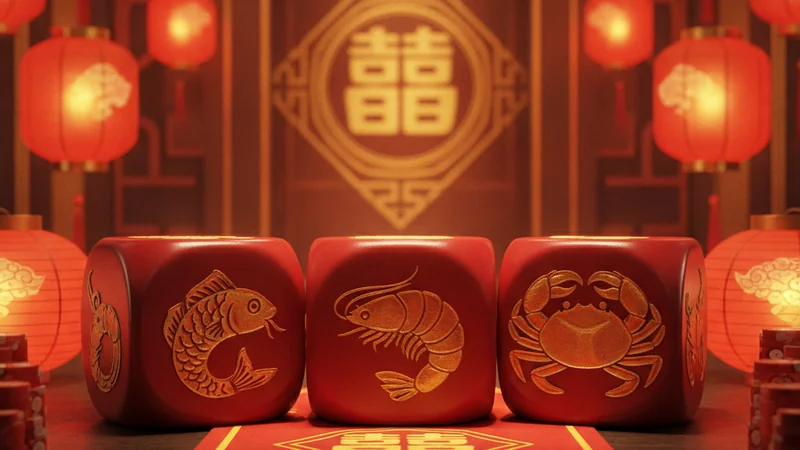
Yee Hah Hi is a traditional Chinese dice game using dice featuring six unique symbols: fish (Yu), prawn (Har), crab (Hai), rooster (Kai), coin (Qian), and calabash (Hu). Available at most Malaysian live casinos through Asian live casino providers, Yee Hah Hi is extremely popular at Chinese New Year celebrations and in Southeast Asian gaming venues. It is simple, colourful, and entertaining for players of all experience levels. Whether you grew up around the paper mat at reunion dinners or have only just noticed the rooster dice in a live lobby, this page gives you the payout ladder, the true odds behind each symbol, and an honest read on what the game costs so you can price the tradition properly.
What is Yee Hah Hi?
Yee Hah Hi (also written "魚蝦蟹" and known as Fish-Prawn-Crab in Cantonese) is played with three special dice, each carved with the same six pictures rather than ordinary numbers: fish, prawn, crab, rooster, coin, and calabash. Before the shake, you simply back which symbol or symbols you think will land face-up. Once the dealer reveals all three dice, your return scales with how many of them show your chosen picture, the more matches, the bigger the win, which makes it one of the easiest live games to pick up in a single round.
Where These Figures Come From
The payout ladder, symbol probabilities and house edge figures on this page are the published mathematics of a three-dice game, cross-checked against the studios' table rules and the in-game information panel and against live Malaysian lobbies under our review methodology. Side menus differ between studio implementations, so where a table adds colour-group or paired-symbol bets we point you at its own paytable rather than quoting a price we have not seen on that table.
How to Play Yee Hah Hi
- Choose your symbol(s). Select one or more of the six symbols to bet on.
- Place your bet. Wager on your chosen symbol appearing on 1, 2, or all 3 dice.
- Dice revealed. Three symbol dice are shaken and revealed.
- Count appearances. If your symbol appears on 1 die: pay 1:1. Two dice: pay 2:1. Three dice: pay 3:1.
- No appearances. If your symbol does not appear on any die, your bet is lost.
Strategy Tips
Tip 1: Probability Per Symbol
Each symbol has a 1/6 chance of appearing on each die. Across three dice, the probability of your symbol appearing at least once is approximately 42%. This makes Yee Hah Hi reasonably frequent for single-symbol wins.
Tip 2: Spread Bets Across Multiple Symbols
Betting on 2-3 different symbols simultaneously increases your probability of at least one win per round. Adjust your per-symbol stake to maintain your total round budget while enjoying broader coverage.
Tip 3: Don't Overvalue the Triple Payout
Seeing all three dice land on the same symbol pays 3:1 and feels like the prize to chase, but the odds of any one symbol filling all three faces are only about 1 in 216. Treat those triples as a pleasant bonus rather than a plan, anchoring your bets on the far more frequent single and double matches keeps your bankroll steadier across a long session of Yee Hah Hi.
Which Providers Offer It
Symbol dice are an Asian-studio speciality, so the tables come from providers built for this market rather than the large Western live casino names.
- Allbet. Builds its catalogue around traditional Chinese and Hong Kong table games, and is one of the studios Malaysian lobbies turn to for the symbol dice family.
- SA Gaming. Runs traditional symbol dice alongside its wider Asian live range, with its own studio presentation.
- Game Play. Carries a broad spread of Asian dice and table games, and often lists the game under one of its other names.
Because the game answers to several names, a lobby search for one spelling can come back empty while the table sits there under another. Try Fish Prawn Crab and Hoo Hey How before concluding an operator does not carry it.
Sic Bo's Mathematics in Festival Dress
Under the symbols, Yee Hah Hi runs on exactly the arithmetic of a numbered dice game. Three dice, six faces each, the same 216 equally likely combinations, with fish, prawn and crab standing where the numbers would be. A single-symbol bet behaves precisely like Chuck-a-Luck's single number, paying one, two or three to one as your symbol appears on one, two or all three dice, and carrying the same steep price, close to eight per cent on the standard ladder. Knowing that mapping matters, because the cheerful presentation hides familiar economics, and a player who would think twice about an eight per cent bet on a numbered die should think exactly as hard when the die wears a rooster.
The Symbols Are the Point
And yet reducing the game to its maths misses why it exists. The six symbols carry generations of association, the fish for abundance, the coin for wealth, the calabash for fortune, and the game's presence at Chinese New Year tables across Malaysia and Singapore is closer to tradition than to gambling strategy. Players back the symbols they were raised to favour, the table fills with festival colour, and the mathematics politely waits outside. The live studio version preserves that register faithfully, and across Malaysian lobbies its busiest weeks track the lunar calendar as reliably as any reunion dinner.
One Family, Several Names
The game answers to Yee Hah Hi, Hoo Hey How, and Fish-Prawn-Crab depending on the dialect and the region doing the naming, and most Malaysian live casinos carry the family under more than one banner, with Fish Prawn Crab the sibling listing. Menu details differ slightly between studio implementations, some offering colour-group bets across the red and green symbols, some adding paired-symbol wagers, and the paytable panel remains the referee on prices. For the numbered original with its far wider bet menu, Sic Bo is the ancestral table, and the better home for money that cares about the edge.
Bringing the Festival Table Home Without the Arguments
Anyone who has played the paper-mat version at a family gathering knows its one recurring feature, the disputed payout, the uncle certain his prawn appeared twice, the mat's faded symbols not helping. The studio version's quiet gift is settlement, every roll on camera, every payout automatic, the tradition preserved with its friction removed. What it cannot import is the mat itself, the physical spread of coins across hand-drawn symbols, and honesty says something is lost there. The screen version is the tradition's clean modern edition rather than its replacement, and most families who play both keep it that way, the mat for the reunion, the stream for the eleven months between.
Played on those terms, stakes stay naturally sensible, festival money rather than bankroll money, and the game's steep single-symbol pricing matters less than it would at a table someone visits nightly. Tradition, priced as tradition, is a fair purchase.
Pricing the Tradition in Ringgit
The arithmetic here is unusually clean, which makes it easy to decide in advance what an evening should cost. A single-symbol bet wins something on about 42 per cent of shakes, and the payout ladder of 1:1, 2:1 and 3:1 for one, two or three matches leaves a house edge close to eight per cent. That is roughly seven times the price of a baccarat banker bet at 1.06 per cent and close to three times the price of a single-zero roulette wheel at 2.70 per cent, so it belongs in the entertainment column rather than the value column.
Put numbers on it. A live symbol dice table shakes roughly 40 to 50 times an hour once the betting window and the reveal are counted. At MYR 10 on one symbol every round, 45 shakes is MYR 450 of turnover and about MYR 36 an hour in expected cost. Spread the same MYR 10 across three symbols at a bit over MYR 3 each and nothing improves, because three bets at the same price are still that price. What spreading buys is a win on most rounds instead of on two rounds in five, which is comfort rather than value, and comfort is a perfectly reasonable thing to buy as long as you know that is the purchase.
The mistake to name is the triple. Three matching faces pays 3:1 and lands about once in 216 shakes for any given symbol, which at 45 shakes an hour means roughly one appearance every five hours of play. Players who chase it by lifting stakes after a dry run are paying the eight per cent margin on a larger turnover to reach an outcome the ladder never priced generously in the first place. The triple is the cheer, not the plan.
Set the evening's figure in Ringgit before the first shake and treat it as festival money, the way the paper mat was always played. If the number keeps needing topping up, the deposit limits, session reminders and Malaysian support services on our responsible gambling page are the practical tools.
SA Gaming runs the studio catalogue where most Malaysian symbol dice tables originate. Fish Prawn Crab is the same family under its Cantonese name, and often the listing a lobby actually uses, while Sic Bo is the numbered ancestor, with a wider menu and several bets priced far better than these, covered further in Sic Bo strategy for Malaysian players. Chinese New Year live casino promotions is worth reading before the festival fortnight, when these tables are at their busiest.
Common Questions
Is any symbol luckier than the others?
Culturally, endlessly debatable. Mathematically, the dice are balanced and every symbol appears with identical frequency, which the festival table has always cheerfully ignored.
How does it differ from Sic Bo?
Symbols replace numbers, which removes the totals-based bets and shrinks the menu to symbol appearances and small combinations. The surviving bets carry Chuck-a-Luck economics rather than Sic Bo's better anchors.
When is the game busiest?
The fortnight around Chinese New Year, without question, when the tables fill with once-a-year players honouring the tradition. The dice behave identically in quiet months, at better minimums.
Can I play Yee Hah Hi outside festival season?
The tables run year round at Malaysian live casinos, quieter and often at friendlier minimums outside the lunar new year rush. The symbols carry their meanings in any month, and regulars who love the format point out that the dice neither know nor care what week the calendar shows. The festival simply brings the crowd, never the luck.
However you come to the table, tradition, curiosity or festival habit, the game rewards being taken lightly. Small stakes, familiar symbols, a shake and a cheer, and the oldest kind of dice evening there is, now streaming in high definition with the payouts settled before the laughter fades.